

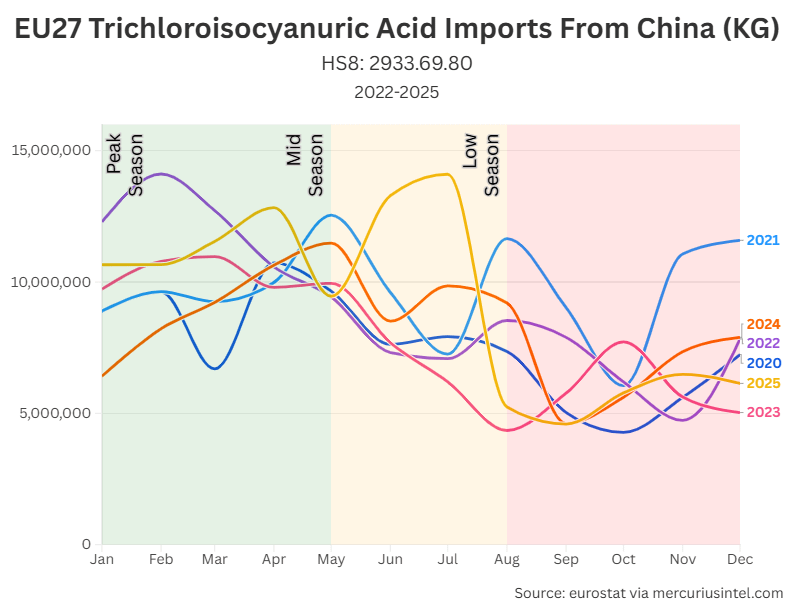
The European Commission has recently initiated an “absorption reinvestigation” into imports of trichloroisocyanuric acid (TCCA) from China. The core allegation? That Chinese exporters have been deliberately lowering their export prices to neutralize the remedial effect of anti-dumping duties imposed in late 2025.
It sounds like a straightforward case of trade circumvention. But look closer at the data, and a different story emerges—one dictated not by policy, but by global commodity markets.
The Urea Connection
TCCA production is heavily dependent on urea, a volatile commodity. When we overlay the price of TCCA exported to the EU with the global benchmark price for E. Europe Urea, the “absorption” narrative begins to collapse.

Between late 2025 and April 2026, both TCCA export prices and global urea benchmarks plummeted in near-perfect synchronization.
Market Dynamics vs. Intentional Absorption
The Commission’s investigation assumes that price decreases in the post-November 2025 period were a calculated effort to absorb duties. However, data from the World Bank’s “Pink Sheet” confirms that input costs for producers faced massive, market-driven swings during this exact window.
If an exporter reduces their prices because their primary raw material—urea—dropped by nearly 10% in a single month, is that “absorption,” or is that simply efficient market pricing?
What’s Next?
For companies currently being scrutinized, the defense is clear: Correlation is not causation. To successfully counter these allegations, exporters must move beyond the Commission’s simplistic view of trade flow and present a comprehensive cost-basis model.
By demonstrating that export price fluctuations are a direct reflection of underlying raw material volatility, the industry can force a re-evaluation of whether these trade defense measures are protecting European producers or simply distorting the reality of the global chemical market.
This analysis is based on public European Commission trade defense notices and independent commodity pricing benchmarks. The following interpretation represents my personal analysis and may reflect a particular perspective on market data.